
Ohio Court Docket
Ohio court docket records are public files kept at Courts of Common Pleas in all 88 counties. The Clerk of Courts in each county manages them. You can search these records online or at the courthouse. Many Ohio counties have free search tools on their official sites. Look up a case by name or case number. Some portals let you filter by date range or case type. Court docket entries, case filings, and hearing dates are all part of the public record. You can also visit in person. If you need copies of an Ohio court docket sheet or other case documents, contact the Clerk of Courts in the county where the case was filed. Most offices pull records and make copies the same day.
Ohio Court Docket Overview
Search Ohio Court Docket Online
The Supreme Court of Ohio runs a public docket system with case records going back to January 1, 1985. You can view filings, opinions, and full case histories. The system covers daily case announcements and orders. It also has a Case Activity Notification tool. Sign up and get email alerts when a case you track gets an update. The court livestreams proceedings and gives virtual access to oral arguments as well.
For county-level Ohio court docket records, each Clerk of Courts has its own search portal. Big counties tend to have the best tools. Hamilton County's Clerk of Courts runs a search that covers criminal, civil, traffic, and municipal court cases going back to 1974 for some case types. You can search by name, case number, or parcel ID. The system has options like case cost statements, judgment interest rates, and grand jury reports. Under Rule 45(C) of the Rules of Superintendence for Ohio Courts, no clerk is required to offer remote access to every file. If a record is not online, you may need to visit the office or submit a request.
Franklin County's Case Information Online covers Common Pleas criminal and civil cases, domestic relations matters, and 10th District Court of Appeals cases. The docket entries match the official court docket. But the data is just a copy of the official record. For verified court docket info, visit the courthouse.
To search Ohio court docket records online, you need:
- Full name of at least one party in the case
- The case number if you have it
- County where the case was filed
- Date range to narrow your results
Note: Online court docket data can lag 24 hours or more behind actual court filings, so check back if a recent case does not show up right away.
Ohio Court System Structure
Ohio has one of the largest court systems in the country. The Supreme Court of Ohio sits at the top with seven justices. They review appeals and interpret the state constitution. Below that are 12 District Courts of Appeals that cover all 88 counties under Ohio Revised Code § 2701.03. Panels of three judges hear most cases. Each county has a Court of Common Pleas. This is the main trial court in Ohio. It handles felony criminal cases, civil disputes over $15,000, and domestic relations matters. The Clerk of Courts files, dockets, indexes, and preserves all pleadings for these cases.
Municipal courts deal with smaller matters. Under ORC § 1901.01, they handle misdemeanor criminal cases, traffic violations, and civil claims up to $15,000. Small claims divisions take matters up to $6,000. Over 100 municipal courts sit across Ohio. County courts and mayor's courts round out the local level.
The Ohio Clerk of Courts Association has served clerks in all 88 counties since 1940. Clerks are elected to four-year terms. They file, docket, and index every court pleading. They also collect fines, fees, and court costs. The office traces its roots to the 1802 Ohio Constitution, which set up a Clerk of Courts for each county. Ohio's 88 counties now run some of the most computerized Common Pleas court systems in the country.
Court Docket Access in Ohio
Ohio court docket records are open to the public by law. The Rules of Superintendence set the standards. Rule 44 defines what counts as a case document. It also requires parties to strip personal identifiers like Social Security numbers and full financial account numbers before filing. Rule 45 confirms that court records are open for public inspection.
Many clerks have put their court docket systems online. The Cuyahoga County Court of Common Pleas docket lets you search criminal and civil cases by defendant name, case number, or date. Other Ohio counties use systems called Courtview or eAccess. Some show document images. Others only show the docket sheet with basic entry summaries. The level of detail depends on the county.
The Cuyahoga County Clerk of Courts portal below shows one example of an Ohio court docket search tool used by a major county.
Cuyahoga County Court Docket Portal provides one of the most complete online search tools in Ohio.
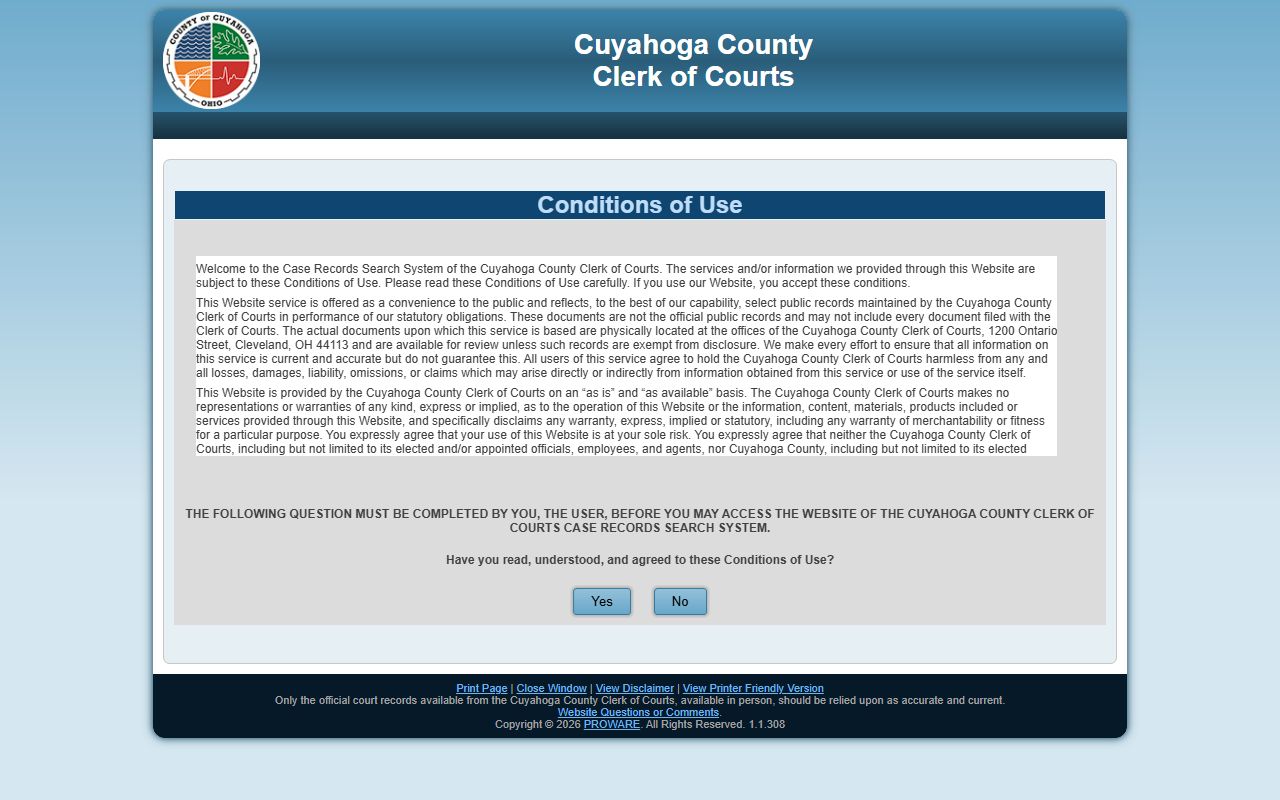
The system merges data from the Common Pleas Court's criminal and property divisions into one searchable database for public use.
In-person access works at every courthouse. Walk into the Clerk of Courts office during business hours. Ask to see a case file or get a copy of the court docket. Staff search by name or case number. Some Ohio counties also accept mail and fax requests for records.
Ohio Public Records Laws
The Ohio Public Records Act under ORC § 149.43 says all public offices must make records available for inspection. Courts fall under this rule. You do not have to give your name. You do not have to say why you want the records. The office must respond promptly. If you want copies, the office can charge for the cost of making them, but they cannot inflate the price.
If an office refuses your request, the law gives you a path. You can file a mandamus action in court. If you win, the court may award your legal fees plus $100 per business day the office failed to comply, up to $1,000 in statutory damages. That provision keeps most offices from stalling on records requests.
Not every record is public. The law carves out exceptions. Medical records are off limits. Trial preparation records are protected. Under ORC § 2933.31, law enforcement can withhold confidential investigatory records if release would hurt an active case or put someone in danger. Grand jury proceedings are secret under ORC § 2313.07. Those records never show up on a public Ohio court docket. Probation and parole records are also restricted from public view.
Get Ohio Court Docket Copies
Contact the Clerk of Courts in the right county. You can go in person, call, or send a written request. Most offices charge per page for plain copies. Certified copies cost more. They carry the court seal and work for legal purposes. Fees vary by county, so ask before you order.
The screenshot below shows the Franklin County Case Information Online system, which is one of the largest court docket search portals in Ohio.
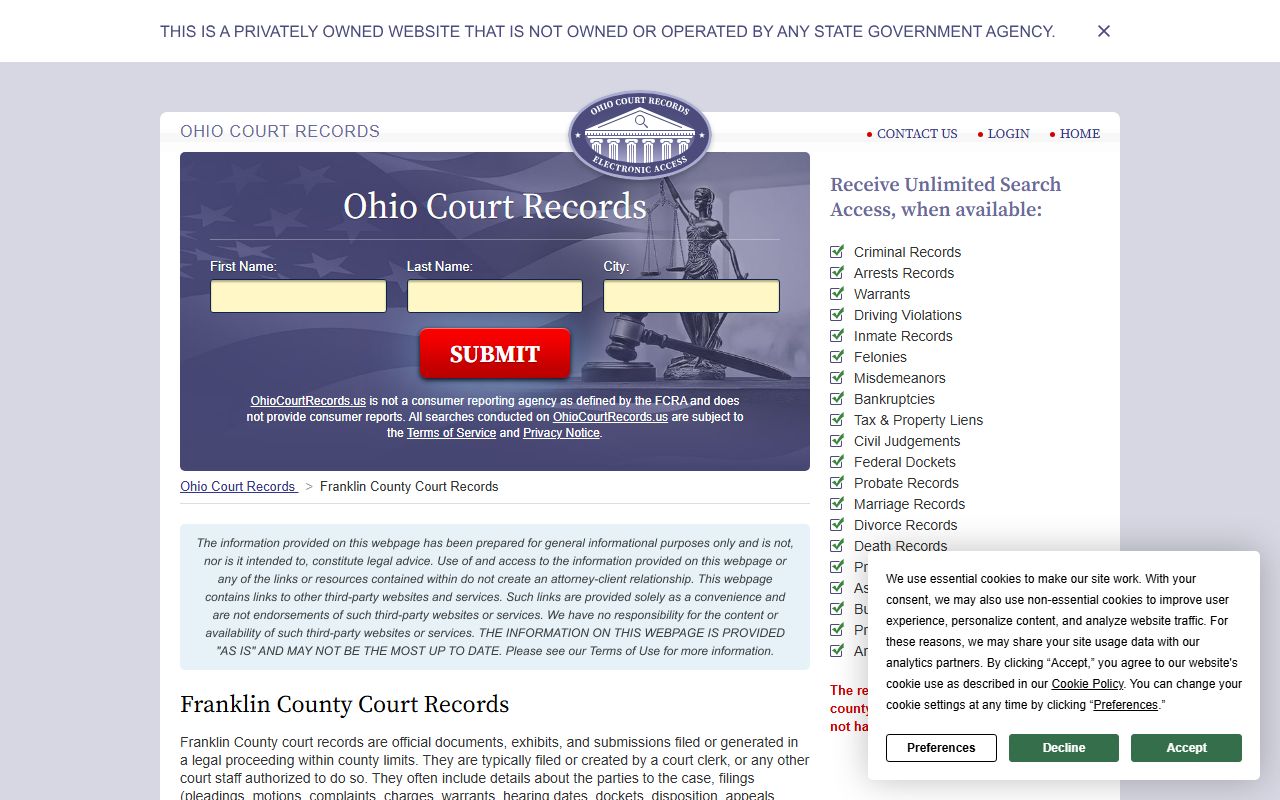
The system was built by the Franklin County Clerk of Courts and the Franklin County Data Center for public access to Common Pleas, domestic relations, and appellate court docket records.
The Ohio Court of Claims has its own online filing system called Odyssey eFileOH. It is open around the clock. The filing fee for a new complaint is $25. You can track case status and view filed documents through the portal. For claims against the state, the process typically takes 12 to 24 months from filing to decision. The state agency gets 60 days to file an investigation report, then the claimant has 21 days to respond.
Note: Some Ohio counties only have digital court docket records going back to the 1990s or 2000s, so older cases may require a paper archive search.
Sealed Records in Ohio Courts
Some Ohio court docket entries are sealed or restricted. Under ORC § 2953.52, eligible adults can apply to seal their criminal records after completing their sentence. The waiting period depends on the charge. Felonies take longer. Certain violent crimes and sex offenses can never be sealed. The applicant must have no more than one felony or two misdemeanor convictions to be eligible.
Juvenile records have separate rules. ORC § 2151.355 allows people to seal juvenile court records after turning 18 or after the case ends. Once sealed, the case drops off the public court docket. The person can deny it exists in most situations. Sealed records can still be accessed by law enforcement and certain licensing boards under limited conditions. If you search a court docket and a case does not appear, it may have been sealed by court order.
Legal Help for Ohio Cases
Ohio Legal Help connects people with free legal resources. It covers all 88 counties. The site can point you to the right Clerk of Courts office for your area. It also provides self-help guides and contact info for legal aid programs across the state.
The Ohio Court of Claims handles public records disputes when a government office refuses to release records. You can file a complaint for $25. Many Ohio courthouses also have self-help centers with forms and guides for people who represent themselves. Check with the Clerk of Courts in your county for what help is available.
Browse Ohio Court Docket by County
Each of Ohio's 88 counties has a Clerk of Courts that manages the court docket. Pick a county to find local search tools, contact info, and filing details.
Court Docket in Major Ohio Cities
Ohio city residents file cases at the Court of Common Pleas in their county. Pick a city to find which court docket system handles your area.